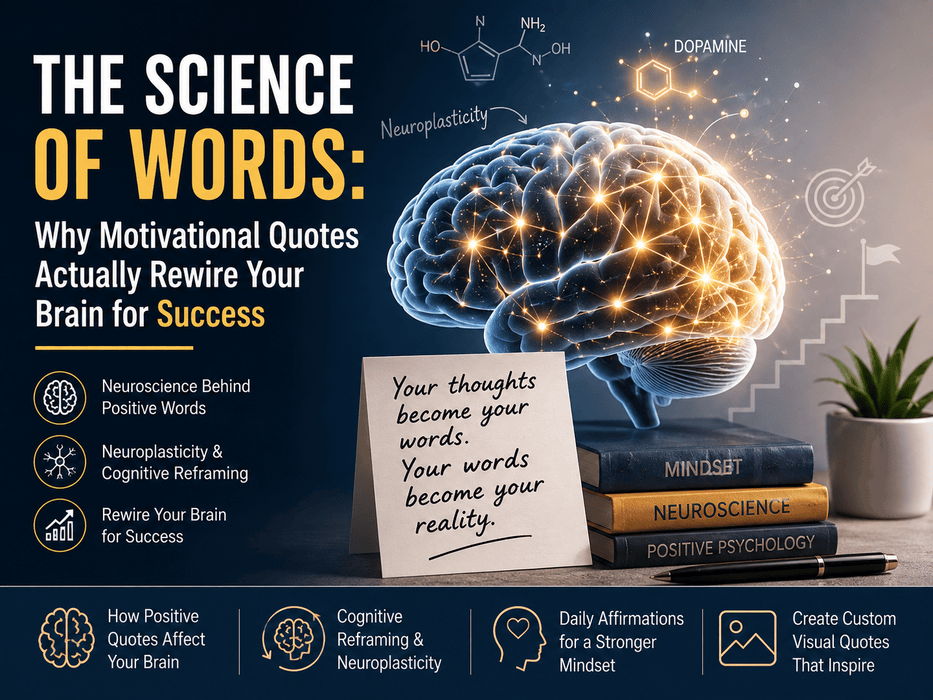
Words can do more than communicate information. When we read a meaningful statement, the brain processes the language, connects it with context and prior knowledge, and builds an interpretation of what the words mean. Research on self-affirmation and self-talk also suggests that language can influence self-related processing, motivation, and behavior under particular conditions. NCBI research on self-affirmation and the brain
That is why motivational quotes can be useful—but the phrase “rewire your brain for success” needs some qualification. Neuroplasticity refers to the brain’s ability to change with experience and learning; it does not mean that reading one positive sentence permanently changes your brain. A better question is how meaningful words can influence the way you process a goal, challenge, or belief over time.
For more inspirational material to explore alongside this science, visit GetMotivatedQuotes.
Why Your Brain Loves Quotes: The Neuroscience Engine Behind Inspiration
How Positive Quotes Affect the Brain at a Cellular Level
Reading begins with the brain converting written symbols into language and meaning. Neuroscience research on reading comprehension shows that understanding text involves a distributed language network rather than a single “reading center,” with additional regions helping integrate words with context, background knowledge, and broader meaning. Source NCBI review of the neurobiology of reading comprehension
At the cellular level, learning can modify the strength of connections between neurons, which is one part of the broader phenomenon known as neuroplasticity. Hebbian models of learning describe how patterns of neural activity can contribute to changes in synaptic strength. Source NCBI research on Hebbian plasticity and synaptic change
This does not prove that a motivational quote instantly creates a new neural pathway. The more defensible explanation is that repeated learning and meaningful mental activity can participate in neural adaptation over time.
Dopamine Release From Inspiring Words and Goal-Seeking Pathways
Dopamine is involved in motivation, learning, reward processing, and the evaluation of outcomes. Research on dopamine neurons shows that they can signal information about reward prediction, motivational value, and cues associated with future outcomes. Source NCBI review of dopamine and motivational control
This is relevant to motivational language because a quote can make a goal, value, or desired future outcome more mentally salient. However, there is not enough evidence to claim that simply reading an inspiring quote automatically produces a dopamine spike. Dopamine responses depend on reward expectations, context, salience, and learning rather than on positive wording alone. Sourcw NCBI review of dopamine, reward prediction, and learning
The useful connection is therefore between meaningful language, motivation, and goal-directed thinking, not a guaranteed chemical reaction to every inspirational sentence.
The Psychology Behind Motivational Quotes and Neuroplasticity
Neuroplasticity and Positive Self-Talk: Rewiring Neural Pathways
Neuroplasticity and positive self-talk are related, but they are not the same process. Neuroplasticity describes the brain’s capacity to adapt through experience, while self-talk is the deliberate use of language to guide attention, interpretation, or behavior.
A systematic review examining 47 studies reported beneficial effects of positive, instructional, and motivational self-talk on performance, while also finding that some commonly repeated assumptions about self-talk were not consistently supported. Source PubMed systematic review of self-talk
A later meta-analysis of 32 studies found a positive moderate effect of self-talk interventions on sports-task performance, with the size of the effect varying according to factors such as task type and the form of self-talk used. Source PubMed meta-analysis of self-talk and performance
So positive affirmations and neuroplasticity should not be presented as a simple formula in which repeating a sentence automatically changes the brain. The evidence is stronger for structured self-talk and meaningful self-affirmation than for generic positive repetition.
The “Coaching Effect” and Parasocial Mentorship
People can develop parasocial relationships with public figures and media personalities, and parasocial interaction is an established subject of media and communication research. Reviews of this literature examine how audiences can form one-sided relationships and perceptions of connection with people they encounter through media. Source NCBI review of parasocial relationships and interactions
That helps explain why a quote associated with a respected author, leader, philosopher, or other public figure may feel more authoritative or personally meaningful to a reader. The words can be interpreted in the context of what the reader already believes about that person.
But the stronger claim that reading a quote from someone such as Marcus Aurelius or Peter Drucker literally simulates direct mentorship in the brain or reduces cognitive hesitation is not established by the evidence reviewed here. It is better described as a possible psychological interpretation rather than a proven neurological mechanism.
Quotes for Cognitive Restructuring: 3 Core Psychological Triggers
Trigger 1 — Resilience and Cognitive Reframing Quotes
Cognitive reframing quotes can serve as prompts for looking at a difficult situation from a different perspective. Cognitive reappraisal is a well-studied emotion-regulation process in which people change the interpretation of an emotional situation, and neuroimaging research has linked reappraisal with increased activity in cognitive-control regions and altered amygdala responses. Source: NCBI meta-analysis of cognitive reappraisal and brain activity

This is where quotes for cognitive restructuring can become useful as practical prompts. A resilience quote might encourage someone to replace “This failure proves I cannot do it” with a more useful question such as “What can this result teach me about the next attempt?”
The quote is not performing the restructuring by itself. The reader is doing the cognitive work by reconsidering the meaning of the event.
Trigger 2 — Strategic Focus and Habit Consistency Quotes
A quote about discipline, consistency, or strategic focus can function as a compact reminder of what needs attention. This connects naturally with self-talk research, which has found beneficial effects for both motivational and instructional forms of self-talk in performance settings. Source: PubMed research on motivational and instructional self-talk

The practical value comes when the message becomes a cue for behavior: start the task, follow the plan, continue after a setback, or focus on the next step.
That makes strategic focus and habit consistency more useful concepts than simply collecting inspirational sentences.
Trigger 3 — Emotional Regulation and Stress Reduction Quotes
Perspective can influence how people respond to emotionally difficult situations. Research on cognitive reappraisal shows that changing the meaning assigned to an emotional event can engage cognitive-control processes and alter emotional responding. Source: NCBI research on cognitive reappraisal and emotion regulation
A quote can therefore work as a reminder to pause and consider another perspective before reacting. This makes motivational language potentially useful for mental shortcuts for emotional regulation, but it would be inaccurate to claim that a quote automatically “soothes the amygdala” or lowers cortisol unless a study has directly demonstrated that effect for that specific intervention.
Dual-Coding Theory: How Visual Imagery and Typography Supercharge Retention
The Science of Visual Accentuation in Neural Encoding
Dual-coding theory proposes that information can be represented through both verbal and non-verbal systems. When the same idea is presented with language and a meaningful visual representation, the two forms can provide complementary routes for learning and recall. Source: NCBI
Research on learning science has applied this principle to education, reporting that multiple representations can improve learning and memory. At the same time, adding more representations can increase cognitive load, so a visual should support the message rather than overwhelm it.
This gives the science of positive thinking quotes a practical visual angle: the words should remain clear, while the image, layout, and typography reinforce the central idea rather than compete with it.
Creating Custom Visual Quotes to Anchor Mindset Shifts
A custom quote graphic can combine the statement with an image, background, typography, and visual hierarchy. GetMotivatedQuotes’ Create Quote tool lets users enter quote text and attribution, choose an image or color background, adjust typography, and download the resulting quote card as a high-resolution PNG. GetMotivatedQuotes Quote Creator
For a quotes to shift your mindset workflow, choose the message first, then select a visual that supports its meaning. Keep the text readable and avoid decorative elements that distract from the statement.
Why the Right Visual Context Matters
The benefit of visual design is not simply that “images are better than words.” Dual-coding research suggests that learning can benefit when verbal and visual representations complement each other, while unrelated or excessive information can increase cognitive load. Source: NCBI
A strong quote graphic therefore has one clear message, readable typography, and a visual context that helps the reader understand or remember the idea.
Do Motivational Quotes Actually Work? Science vs. Passive Reading
The Active Processing Pitfall: Why Mere Reading Isn’t Enough
The evidence does not support a simple rule that reading motivational quotes automatically produces lasting motivation. Research on self-affirmation has found small but reliable effects on message acceptance, intentions, and subsequent behavior, but these studies involve specific psychological interventions rather than ordinary passive quote consumption.
This distinction matters. Seeing a quote for a few seconds is different from reflecting on why it matters, connecting it to a personal value, and using it to guide a decision.
Turning Passive Consumption Into Mindset Shifts
A quote becomes more useful when it prompts active reflection. One simple method is to ask three questions: What does this mean for my situation? What part of it applies to my goal? What can I do differently today?
This approach is consistent with research showing that self-affirmation can influence receptivity and behavior under certain conditions. A meta-analysis found small positive effects across message acceptance, intentions, and behavior, while also emphasizing that the effects were modest.
Do Motivational Quotes Actually Work for Everyone?
No single motivational message will affect everyone in the same way. Research on self-affirmation indicates that its effects can depend on factors such as psychological threat, available resources, and timing. Source: PubMed
That means the better question is not whether motivational quotes “work” in every situation, but whether a particular message is relevant enough to help a particular person reflect, focus, or act.
Daily Affirmation Protocols: How to Rewire Your Brain for Success
The Psychology of Daily Affirmations in Morning Routines
A daily affirmation practice is better understood as a structured opportunity for self-reflection than as a guaranteed method to rewire your brain for success. Research on self-affirmation commonly involves reflecting on personally important values, attributes, or relationships rather than simply repeating a positive sentence without context.
In one fMRI study, participants who completed a self-affirmation exercise showed greater activity in the ventromedial prefrontal cortex while viewing health messages, and greater activity in that region was associated with increased objectively measured physical activity afterward.
The study does not establish that morning affirmations themselves produce the same effect, so claims about special “alpha brainwave” receptivity after waking should not be presented as established fact.
Building a Personalized Visual Quote Stack for Long-Term Growth
Choose a small set of messages connected to areas you genuinely want to work on, such as resilience, focus, discipline, or confidence. Then give each message a practical purpose instead of collecting quotes simply because they sound inspiring.
For example, one quote can serve as a reminder to persist after setbacks, another can cue focused work, and another can remind you of a personal value. Research on self-affirmation supports the importance of personally meaningful values, while self-talk research suggests that deliberate verbal cues can support performance in appropriate contexts.
You can browse motivational quotes and turn a selected message into a visual card with the Create Quote tool.
A Simple Daily Quote Routine
Keep the practice small enough to use consistently. Read one quote, connect it with a value or current goal, write one sentence about why it matters, and choose one action that puts the idea into practice.
This creates a useful sequence:
Quote → Reflection → Personal meaning → Action
The purpose is not to stay motivated every minute of the day. It is to turn a meaningful statement into a cue for thinking and behavior.
Dual-Coding Theory: How Visual Imagery and Typography Supercharge Retention
The Science of Visual Accentuation in Neural Encoding
Dual-coding theory proposes that people can represent information through verbal and nonverbal systems. When words are paired with a relevant visual representation, the two forms can provide complementary information that supports learning; however, adding unnecessary visual material can also increase cognitive load. Source: NCBI
That makes visual quote design more than decoration. A clear image can provide context for the words, while readable typography keeps the main message accessible.
Creating Custom Visual Quotes to Anchor Mindset Shifts
A useful visual quote should make the message easier to notice and revisit rather than compete with it. Keep the quotation prominent, use typography that remains easy to read, and choose an image or background that supports the meaning.
You can create a personalized visual quote with the Create Quote tool.
How Visual Quotes Can Support Recall
Research on inspirational quotations has explored whether meaningful context can influence memory. In one study involving university students, abstract vocabulary presented through inspirational quotes produced significantly better immediate and delayed recall than the comparison condition using plain sentences. Source: ResearchGate
The finding is specific to that study and should not be turned into a claim that every visual quote improves memory. What it does show is that context and meaning can matter when people encounter information.
Do Motivational Quotes Actually Work? Science vs. Passive Reading
The Active Processing Pitfall: Why Mere Reading Isn’t Enough
Research does not show that simply reading motivational quotes guarantees lasting motivation. The strongest evidence in this area comes from structured psychological processes such as self-affirmation and self-talk rather than passive exposure to inspirational sentences. A meta-analysis of 144 experimental tests found small but reliable effects of self-affirmation on message acceptance, intentions, and subsequent health behavior.
This suggests an important difference between reading a quote and using its message.
Turning Passive Consumption Into Mindset Shifts
A quote becomes more useful when it prompts active reflection. After reading one, ask what the statement means in your current situation, which part relates to your goal, and what action it suggests.
This is consistent with research showing that self-affirmation can influence how people respond to messages and can produce modest changes in intentions and behavior under particular conditions. Source: PubMed
Do Motivational Quotes Actually Work for Everyone?
No. Psychological interventions do not produce identical results for every person or every situation.
Research on self-affirmation shows that effects can vary according to factors such as the type of intervention, the participant, and the context in which the affirmation occurs. Source: PubMed
The better question is whether a particular message is relevant enough to help this reader reflect, refocus, or take a useful action.
Daily Affirmation Protocols: How to Rewire Your Brain for Success
The Psychology of Daily Affirmations in Morning Routines
Daily affirmations are often described as a way to rewire your brain for success, but the research is more specific. Self-affirmation experiments generally involve reflecting on personally important values, attributes, or relationships rather than mechanically repeating positive sentences.
One fMRI study found that a self-affirmation intervention increased activity in the ventromedial prefrontal cortex during exposure to health messages, and greater activity in that region was associated with greater objectively measured physical activity afterward. Source: NCBI
There is not sufficient evidence here to claim that waking in a particular brainwave state makes morning affirmations uniquely receptive, so that claim should not be presented as established science.
Building a Personalized Visual Quote Stack for Long-Term Growth
Choose a small group of messages that correspond to real areas of growth, such as resilience, focus, discipline, confidence, or persistence. The aim is not to accumulate as many quotes as possible but to keep a few meaningful ideas available when you need them.
This approach fits the evidence better because self-affirmation research emphasizes personally important values, while self-talk research suggests that deliberate verbal strategies can support performance in appropriate contexts. Source: NCBI and PubMed
Browse the motivational quotes collection to find messages for different goals, then use the Create Quote tool to turn a selected message into a visual reminder.
A Simple Daily Affirmation and Quote Routine
Keep the practice specific: choose one message, connect it to something you value, reflect on how it applies to your current situation, and identify one action that follows from it.
That creates a practical sequence:
Read → Reflect → Personalize → Act
The objective is not to feel motivated every moment. It is to use meaningful language as a cue for more deliberate thinking and behavior.
Find a Quote That Speaks to You and Make It Yours
The most useful motivational quote is often the one that connects with a goal, challenge, or value that already matters to you. Explore the motivational quotes collection on GetMotivatedQuotes to find words that fit what you are working toward, whether you need encouragement, focus, resilience, confidence, or a fresh perspective.
Once you find a message that feels meaningful, turn it into something you can revisit. With the GetMotivatedQuotes Create Quote tool, you can create a personalized visual quote to keep the message visible in your daily routine and share or post it to social media.
The idea is simple: find a meaningful message, connect it to your own goal, and turn inspiration into action.